A friendly journal for introspection, wonder and bliss.

Category Archives: publicbroadcasting

Hired at ASU ...

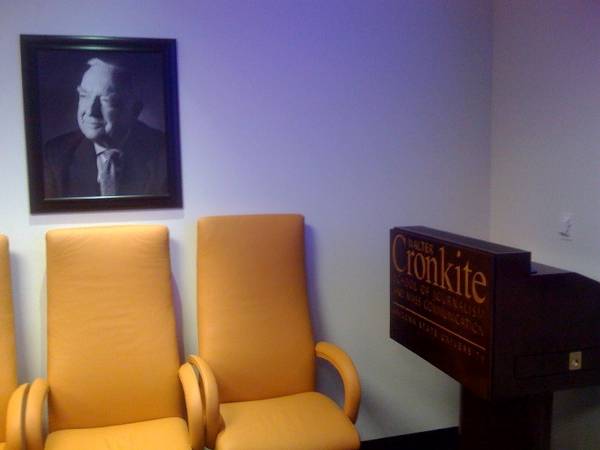
The Executive Boardroom at the Walter Cronkite School of Journalism

Later today, I will be accepting a position at Arizona State University’s Walter Cronkite School of Journalism and Mass Communication as the Lead Web Developer for the Carnegie-Knight News21 journalism initiative under Jody Brannon.

I am honored to have the opportunity to build on the on the work that the universities have started at http://newsinitiative.org/. From what I know right now, I am impressed with their vision and excited about the technologies that they are considering implementing to meet these goals… most notably the discussions at the Django Newsroom Group and the resulting open source software, built specifically for journalism, that this initiative will produce.

KJZZ has been a wonderful home for me for the past nine years. And public radio will always have a place in my heart. I am sure that the work I have participated in and the relationships that I have enjoyed over the years will continue into my work at ASU.

Recent Efforts Creating an NPR Timeline Mashup ...

If you haven’t heard from me in awhile, this is why. Some of you may know I’ve been working recently on an NPR / Timeline Mashup:
http://johntynan.com/scripts/timeline/
(Note: These scripts are in their early stages and are certain to change).

I mostly have been doing this to learn about JSON and to create an example of what can be done using the new NPR API.

This script owes an incredible amount to the NPR Digital Media team. You can find out more about the NPR API here. You can also read about what they’re up to on their blog Inside NPR.org

This also owes a great deal to the Simile Timeline project. You can read the documentation here, or ask a question about the timeline widget here.

I’ve learned a great deal. In particular, the idea of cross-browser data exchange using a “callback parameter” is great! See this simple tutorial. Then too, it’s great to be working in Javascript again.

Let me know if you have any comments on the scripts. This is definitely a work in progress, but I think it’s a work that could definitely go somewhere.

High Level Thinking from Haarsager on the NPR API ...

I just finished listening to the first half of an amazing interview by Steve Gillmour with Dennis Haarsager and the NPR’s Digital Media Team at gillmorgang.techcrunch.com.

I’ve only listened to the first half of the interview, but I was so blown away by the clarity of thought and forward thinking that I heard that I had to transcribe it as best I could, to be sure I got this into my head just right. Here are some selected highlights:


Haarsager: (Loosely quoted) I’m disciple of Clayton Christensen and believe the disruptive innovation is unavoidable. That we need to figure out ways to disrupt ourselves and move forward in innovative ways. The step we’re in right now is realizing that for our company (NPR) and our 280 licensees/members which represent about 800 stations, that the individual portal strategy that we’ve been following ever since the web was invented is not enough. We definitely need those portals but we need to be able to put our content in places that people aren’t expecting it; whether that be through widgets or the open api, or through mobile and other kinds of distribution opportunities. We basically need to be everywhere, rather than expecting people to come to us… that’s not the way a lot of people use the web. And we need to harness the power of search in that regard in a much more powerful way. I’ve been calling it kind of easter egg strategy where we “hide” content in plain sight all over the web and ask people to go out and gather it up.

Gillmor: Hide? Is that something you are about to do or is this something that you are doing?

Haarsager: (Loosely quoted) The Open API is a very important first step. But we’re also looking at creating what we’ve been talking about as “a second prong of digital” something that’s independent in many ways from npr.org but enables stations to collect content on their own and form partnerships with other non-profits in their communities, becoming more important to them, and curating bundles of content that they can place with these partners and also producing content for these partners. The more places that we can deposit the stuff that we do the better chance that somebody will find it either because they visited that site or page rank has been enhanced because we have all this cross-linking out there. We’re actively trying to get that started. This will be consistent with some of the things that I’ve been working on in the past. Trying to make distribution work, but this time starting from an economic perspective rather than from a technology perspective.

Haarsager: It’s kind of geared toward moving from the scarcity world of broadcasting to the abundance world of the web. You know, like any good beaurocracy, us in public broadcasting tend to make a virtue out of a necessity sometimes, and so the notion of having to curate at a very high level all content in a way that is consistent with a broadcast message means that there is very few opportunity for us to, say, help the local nature conservancy group with its particular messaging. But that isn’t to say that this isn’t consistent with our mission. So, if we have the ability through our technology and through our ability to drive traffic to the web to help that group share its message with others in the community and to bring in great ideas from a nature conservancy organization across the country to their own constituents locally. That seems to me a real win, all to the good. And if we can bring to their web site not only that, but npr stories that are consistent with their mission, that’s also really good. So the idea then is to create these little opportunities for service that really aren’t possible in the broadcast environment, but are consistent with what we’re doing. And if you can make yourself more valuable in the community, then often revenue follows from that, from grant opportunities and tax based sources and sometimes from contributors. What we’re trying to do ultimately is to help diversify the economy of public radio in a way that helps us all.

It’s more sophisticated than the Public service publisher portal model in terms of its distribution mode. There we were looking at a portal and a portal that would be expressed in a distributed way over public station web sites, but those are also portals. So here we’re trying to break beyond the bounds of the portal to give us distribution very deeply into a community. So a given station might have a hundred partners locally, ultimately if it was able to put that together, and have content there. And some of that content would also express itself across the country because what they’re doing locally is of importance to somebody in N.C. when their base night be in N.D.. And all that is done in a little bit more planful way than we were looking for on the psp initiative which was to enable stations to make pay per use or subscription plays or simply to distribute the stuff for free, but mostly within the traditional bounds of their local web site. I just think that that’s a dated view of where we ought to be exclusively, and we need to recognize that other non-profits are just as interested in using the web to distribute their content as we are and the barriers to entry are relatively low, so why not do this community level aggregation in order to help everybody.


Amazing! I am seeing the start of a major media network attempting to re-invent itself, in accordance with its mission, on the web. And I’m hopeful that if we approach this vision, we’ll be doing as much good on the web as we’ve been doing on the air for years.

Bob Glazar’s Desk ...

Later this month, Bob Glazar, a long-time fixture in radio fund raising will be retiring from KJZZ. I asked him to give us a quick tour of his desk.

“Radio Engage” Collaboration Enlists Participation, Leverages Open Source ...

Bill Haenel, Dale Hobson and Jack Brighton at Public Media 2008 (Photo Credit: John Tynan)

I’ve worked as a webmaster in public broadcasting for almost a decade. And over the last several years, I’ve seen a slow, pragmatic shift towards increased collaboration in online ventures between local public broadcasting stations and national organizations and producers as evidenced (in NPR’s Podcasting initiative, their relaunch of NPR Music and) in the ongoing Election Collaboration. At the recent Public Media Conference in Los Angeles, Bruce Theriault recalled how he motivated national organizations to collaborate around the 2008 Election by saying, “we will only fund this project if there is collaboration across silos – and if its shared with stations.”

And, while this initiative has exercised great strides towards increased cooperation across numerous organizations, it is my opinion that we still have yet to come into our own as a network. As Bruce Theriault says again “we need to get out of the walled garden of public media and allow the public and other institutions a chance to play.” To a greater or lesser degree, these initiatives are still fairly centrally controlled and (aside from the NPR podcasting initiative) have yet to truly leverage the unique characteristic of public broadcasting as a distributed, network in general, and more specifically the potential of an open source model of collaboration.

Imagine what we could accomplish if we leveraged the combined efforts of the fifty or so interested and capable web professionals all working at public broadcasting stations (not to mention the larger community of programmers and the general public, many of whom happen to love public media… a lot) who would welcome the opportunity to work together towards a number of shared solutions (many of which would have clear benefits to our audience directly).

With that in mind, two weeks ago, I sent out an email to a half-dozen of my colleagues citing my reasons for why it would be useful to begin collaborating around open standards, common practices, and a common software and scripting platform distributed through an open source license. My email went something like this. I proposed that we form:

1) A co-op for public broadcasters to share code – and costs – where we agree on a similar solar system of scripting resources and practices – where we leverage upon an existing codebase and (ideally) share our efforts among stations and among the open source community as well. When needed, we can collectively raise money to pay outside developers to tailor code to our needs and – where we are literally invested in the success of this venture and of each others sites.

2) Rather than relying on our own expertise alone to steer this ship, I propose we talk with a hosting provider or a organization like NPower or NTen or grassroots.org (which specializes in supporting non-profits with their technology needs) about providing hosting and (some of) the ongoing support. This way, we could focus on initiatives which we could band together and leverage shared code and programming costs and not have to be reliant on each other for the maintenance of the system.

Anyone who has gotten to know me over the years knows that this is my baileywick (As evidenced from This post from last year’s conference. However it turns out now this idea is not just important to me… or to a few of my friends… just recently…

The Knight Foundation awarded a $327,000.00 grant to Quiddities to develop an open source website and content management tool for KUSP as a model for public radio stations nationwide.

I’m sure the bright folks at the Knight Foundation and KUSP had given this idea a great deal of thought… and I know there are a ton of other excellent ideas percolating within public broadcasting right now as well… but I can’t help feeling like the guy who happened to step in front of the right parade at the right time. What I’m trying to say is this, I can’t take any credit for this grant, but I can say that I’ve seen it coming, and I could not be more delighted for us all!

With that in mind, as a first step in enlisting input from other stations on this project, Steve Laufer from KUSP got on the phone with Bill Haenel from the Integrated Media Association, Dale Hobson from North Country Public Radio, Jack Brighton from WILL, John Tynan (me) from KJZZ, and Matthew Tift from Wisconsin Public Radio to begin to discuss how we might work together on such a project and what first steps we would begin to take.

Some of the tasks that came out of today’s call were to:

  • Set up a wiki to generate and focus some specific questions about what people would want to see in an open source CMS for their radio or television station.
  • Create a survey to identify and prioritize features of the proposed CMS.
  • Identify the skills and interests of people wanting to be involved in this project.
  • Identify what existing project people would be willing to contribute to this endeavor.
  • Identify how this could promote participation (and interoperability) between stations and national producers and our audience.

Please know that these initial impressions of the project are more personal than they are official. Aside from our conference call, I had only talked with Steve Laufer a few times between sessions at Public Media 2008. I have not been privy to the discussions between KUSP, Quiddities and the Knight Foundation. However, I know I’ve been thinking about this for a long time. I am sure that there is more than a handful of people (like me) to whom the principal parties can turn to for assistance and who will be be happy to devote their energies to the project’s success.

Cross posted at pubforge.org.

Get My Voice ...

The folks at NPR have just launched a site where people can upload their own audio and video. I’m home with a cold today, but I decided to give it a try anyway. Feel free to check it out:

Wikipedia, Wikia and the Future of Free Culture ...

Jimmy Wales, founder of Wikipdia talks about how Wikipedia aims to give people access to the sum of human knowledge.

He describes how Wikipedia is very popular across the globe. Hundreds of thousands of articles in numbers of languages.

He notes how Wikipedia is a charitable organization with only 12 employees. Yet, look at the affect they have on the world.

Spent $1,000,000 in 2006 – supported by small donations from people around the world. (Also gets donations of caching servers around the world.)

Wales goes on to define, what he means by free access to the sum of human knowledge. “Free as in speech, not as in beer.”

The Wikipedia’s license allows you the:
Freedom to copy
Freedom to modify
Freedom to redistribute
Freedom to redistribute modified versions

He goes on to further refine his term the sum of all human knowledge. He describes Wikipedia as an encyclopedia, not a data dump. This is a Global Movement to gather content in every single language.

The folks from Wikipedia ask people to build their own wikipedia in their own language. They have a “Wikipedia academy” which offers seminars on how to edit wikipedia. (note: check http://icommons.org)

He notes, it takes 5 to 10 regular users in a community to sustain regular posting in a paricular language / about a particular subject.

For instance, he tells the story of the “Father of Swahili”. Every night he wrote articles for Wikipedia. This person then reached out to Swahili language bloggers. Then the 5 to 10 contributors gathered together and started helping each other.

Wales goes on to describe Wikia as a completely separate venture. Wikia is like every other kind of book, only it is writing that people build as an online community.

Goal of Wikia is for profit, but it still is freely distributed.

He offers an explanation about why this all is happening… The internet is all about consumer media.

He cites the example of the “Muppet Wiki” as a resource for community created long tail content.

He cites bloggers as performing the function of “Armchair Analysis” and says that “a good blog is equal to the editorial section of the New York Times.”

He points out that Wikipedia aims to embrace neutrality as a core value that Wikipedia should not take a stand on any controversial issue and that it should describe the fight rather than taking a stance.

The nature of wikis is such that there is the potential for content to be destroyed. But points out that writing that survives is writing that people can mutually agree is an accurate description.

In a moment of self-assessment, he notes that Wiki News reporting is not too good. He notes that “News requires infrastrucutre, ability to be patient and wait for news to happen.” Although, one potential exception that he sees as fertile ground for exploration would be for crowdourced sports reporting.

He points out the following lessons for public broadcasters:

– a lot of this is made possible by the creative commons licensing framework

– he asks us to think about how new content could be created from public broadcasting content. To think about community reuse.

- he asks us to think about how we can you release content in a way where we can get people interested in what we are doing. For example: he talks about how he worked to persuade art museums to make high quality photograph available for use on wikipedia – and how that encourages people to go to the museum.

The next section of the presentation is on Wikia and the future of search

(Insert link to Wikia Labs)
Note: this is a political statement about Open Source, about Open Access.

Here, Wales is offering people all t necessary software to set up a Free Search Engine – would this be useful for Jake Shapiro’s Pirate Media Bay initiative? Would this be useful for PBCore?

Sound Exchange Reporting Requirements ...

I have to say, of all the sessions that I breezed into, having missed the first 10 minutes of Bruce Theriault’s informal remarks about Public Radio stations’ responsibilities for reporing to the Sound Exchange was particularly regretful.

Although, I think I can say with certainty that what he had to say, while it likely contained some of the back story and the nuance of detail that I might have missed, that in the end, his message was clear: each station is required to submit quarterly reports based on these requirements:

Every Quarter: 14 day report
Name of Station
Category
Name of Artist
Name of Song
Album Title and Label (or ISRC code)
Number of Plays
Number of Performances

159,140 ATH = 200 people listening 24/7 for a month

If you stream less than that, you are paying $500 a month. If you are streaming more than that, you need to “pay based on performance”. Either way, you need to send them a 14 days per quarter report.

National Programs can no longer file. Each station (or service provider, as the sound exchange calls them)

Stations need to differentiate between Songs (copyright protected material) and Royalty Free Content (via promos, underwriting etc)

Representatives from Streamguys, Abacast and Public Interactive were on hand to help clarify some of the ways stations could meet these requirements using various approaches and solutions:

Abacast, Public Interactive, and Stream Guys all provide Sound Exchange reporting solutions.

For instance, Mike King, CEO of Abacast explains how they will take your playlists and your streaming log files and put together your streaming reports for you. For instance, he shows us a properly formatted file output from Selector music scheduling software. and Explains how they take this data and match it up with information about your live stream. They have created the necessary software to parse these log files. And they are willing to make this technology available to stations for a nominal fee.

Some discussion then turns towards wave file recognition. Yes.com and mediabase.com, and Tune Genie use soundwaves to match “now playing” information with live stream. Tune Genie might be an option for what’s coming down during a syndicated program.

What we need to do:

Configure Selector / Music Master to getnerate standard report then aggregate these reports in with reports from national service proviers like Classical24 or Jazzworks. There are varous options for how to deal with this data once you have your music scheduling software set up. Either way, the next thing you should be thinking about doing is matching up this data with information about listenership to your live stream and there are several ways of going about it:

Automation systems can:
a) send serial data to encoder
b) send an xml log file to the encoder
c) send the xml log file to the streaming server

The folks at StreamGuys suggest on optiion to use is the Simplcast Encoder by SpatialAudio
- can capture serial data from automation system using a “metadata adaptor”
- produces a log file on encoding machine
- can go out to streaming server and capture the number of people listening to the stream
- can do the reporting data for you.

Another option is to use the Oddsock encoder in conjunction with an Icecast server. This option:
- includes an administration interface for remote entry
- can accept log files in xml format

Jon Greenberg – NHPR ...

The surprise presenter of the conference was, for me, Jon Greenberg from New Hampshire Public Radio.

The talked about his initiative to create a “Primary Place Online” where NHPR invited people to “Blog the Primaries”

Greenberg showed quotes from listeners/participants about on how they came away with a increased awareness of other people in their community.

Greenburg promoted these activites in Exeter NH where “people had a lot of opinions about politics.”

Politicians came to town and talked. And people blogged about who they met and what they heard and saw. Greenberg then displayed a smattering of people’s posts about their interactions with the candidates.

NHPR created what Greenberg called a “Blog Squad”. They recruited kids from a vocational school to capture video and asked them to post their footage to youtube. Then Greenberg posted the video on the blog, this helped to continue the discussion online. (His physical curation of this content, his committment to this project on every step of the way was truly inspiring).

He worked with the economist and with slate.com to get this coverage out where others could see it.

Greenberg offered this advice for anyone wanting to undertake this kind of effort:

Give participants a clear task
Give them strong guidance
Ask them specific questions to direct their responses
These people are not Journalists.
Let people know that you do not want an opinion piece.
Ask people to simply report what they saw.

You have to have obvious relevance.
You have to be focused.
And you have to support the people who are contributing to this kind of project.

Just as Rob Curly’s presentation at the IMA in 2005 had me saying, “Man! I want to do that.” Greenberg had me saying, “Man! I want my news director to be that excited, and that involved, in what we’re doing online.”

Technology and Trends: What’s Around the Bend ...

It seems I have a half dozen sets of notes from the conference locked up in my mobile device. It would be good to get these out there for the handful of people who might be inclinded to read them. Here is the first of several…

During one of the afternoon sessions, I listened in on some big thinkers express their thoughts about public media and the changing landscape of the web.

——————
Dennis Haarsager
http://media360.com

Dennis Haarsager opens his presentation by citing Kevin Kelly’s article “Better than Free” he points out the Eight Generatives that give free content value.

If you give conent away for free, what can you sell. How do you create Value?

* Immediacy – getting it soonest
* Personalization – reflecting you
* Interpretation – software free – manual = $
* Authenticity – is it genuine
* Embodiment – how do you want it? Printer, Screen, Phone
* Patronage – Audience wants to support the creators they value – imagine wanting to support this american life and not support the station
* Findability – an unfound masterpiece is worthless

publication:
http://www.kk.org/technium

———————————-
Dennis’ thoughts on Internet Radio are always interesting.

He asks us to check out Slacker.com – an online radio service which gives people an ability for people to be their own program director

Dennis presents an amazing slide for Combining HD Radio with WiMax (insert link here).

Note: HD Radio uses SMIL

I should ask Dennis Harsager about how to run a test of SMIL and HD content. I’ve use smil before. This might be interesting for folks at the station to see.

———————————-
Diane Meringas
blogs.mediapost.com/on_media

Diane Meringas is a hoot. She cites a recent article entitled “Is public media necessary?”

She replies by saying, on the other hand, enabling cultural Literacy is an activity that Public Radio can fulfill

She cites several change agents / niches that public media can “own”:

* Quality
* Social and Community Networking
* All about Connections
*Advertising/Sponsorship=Transactions (don’t be afraid)
* Local = personalization

Knowing about people’s personalization preference allows us to fulfil our mission online. Local in a community is just as important as local in an online community. We have an engaged audience online – that means they are local. They have an interest in us. They deserve to be engaged with their public broadcaster online.

She asks us to check her to do list from two years ago. (link here) chances are, there are a few action items left undone.

———————————-

Doc Searls
http://blogs.law.harvard.edu

I ran into Doc Searls in the elevator. He was just going up to his room after a long day at the conference. He spent the previous day, he tells me, driving back to his home several hours away in LA traffic only to get three hours of sleep and then drive back in to downtown LA to attend more conference sessions. Unless I’m mistaken, nobody paid him to come to this conference. It seems like he does this out of pure passion for public radio. It insipres me to know that someone so knowledgeable sees such value and such potential in what we are doing that he would expend such physical and emotional energy to want to make us aware of the potential that we as public broadcasters hold.

(Insert link to his latest blog for this presentation)

Think Geek Moment: Doc uses a Ramsey FM Transmitter to transmit digital audio throughout his house. I am doing the same with a heathkit FM transmitter as well.

There is no fight – but the Listeners are going to win

Listeners are not consumers anymore – They are producers.
They will bypass anything that gets in their way.

There WILL BE a new business model for public media. The change will come FROM THE LISTENERS to us. The LISTENERS will define THEIR END of their relationship FOR THEMSELVES. This will be called (VRM) Vendor Relationship Management.

As I think about it now, this seems similar to OpenID, in that a person’s personal security data isn’t be managed by the vendor to them, it is is manged by the person to the vendor.

Just because listeners gave us money and we gave them a coffee mug doesn’t mean jack!

For instance, a listener might say, she’s willing to pay money, but only if it goes directly to the activities and programs that this listner appreciate.

Gaguing the temperature of the waters in the seats around me, this idea seems to cause some trepidation among the attendees at Public Media 2008. In one person’s words, “we need stations” these programs cannot exist on their own.

——————————–

Doc goes on to point out that cell phones will be the new radios and televisions will be the new studios.

Internet Radio will be coming through your phone.

Android – Google – Nokia Open Moko – Phones are going to be like PCs.

Websites will be as inefficient as transmitters.

Think river of News: Think: htttp://nytimesriver.com

Archives will be the new killer content.

We’ll work to make archives as easy as possible to find, consume and otherwise use.

* Brands and reputations will be matter more than ever
* Reputations will grow around participation
* Value will increase with engagement

“Full Service” radio will return – with active public stations.

Local COMMERCIAL radio has mostly abandoned the full-service model. There is a public service hole where full live full-service public radio can take advantage.

————————————————-

Rafi Ali
http://Paidcontent.org

Rafi Ali explains that what paidcontent does is “follow the money”

He points out that consolidation and deconsolidation will continue to happen. He cites Google / Yahoo consolidations and Viacom’s decoupling.

“While all these companies fight among each other, they will leave public broadcasting to continue to do what it does untouched… but for how long.”

He says that open networks with phone companies will effect everyone. It will bring better phones and better alternatives. 3G – WiFi – WiMax. He cites one example of this effect, how Nokia decided to change its company from ground up.

This will change all the ways we consume media. Because of faster networks – online and mobile are merging. Expectations will progress from how well our content works on the web. The public will start to turn to how well our content works on the phone.

The shows will matter more than the brand. The people, the talent, the personalities will matter more. People will time-shift, they will podcast, they will become their own program directors. The relationship with PEOPLE and the shows they produce are important to listeners and they will want to support these things specifically – not so much the station itself.

Face to Face will matter a lot. Events, Getting Together – will matter a lot. Events will be a huge part of a program’s revenue.

He asks us to look to the example of “Brad Sucks” as a person who makes a good living giving away content and getting donations.

Aether Child Theme by altamente decorativo & bendler.tv | built on Thematic Framework